African clay jar

African clay jar

It is a clay jar from early 20th century West Africa collected by the Cleveland Museum of Art. This pottery jar is made of red clay material, with a diameter of 35.7 centimeters (14 1/16 inches) and an overall height of 36.9 centimeters (14 1/2 inches). It showcases the artistic characteristics of the Nupe style, crafted by unknown potters. This work is not only a practical item, but also embodies the aesthetics and techniques of traditional African pottery. The Cleveland Museum of Art purchased this item through the John L. Severance Fund, with the serial number 1995.210.
Flower and Bird Vase

Flower and Bird Vase

Flower and bird vases are porcelain from the late Joseon Dynasty and were made around the late 19th to early 20th century. This porcelain vase is decorated with underglaze blue, with an outer diameter of 34.3 centimeters and an overall height of 49.4 centimeters. Its design is themed around birds and flowers, reflecting the delicacy and beauty of the porcelain art of the Joseon Dynasty. The porcelain vase was donated by the Mountain Chamber of Commerce to the Cleveland Museum of Art in memory of Jiro Yamanaka, with donation number 1989.117. This work not only showcases the traditional culture of the Korean Peninsula, but also reflects the craftsmanship of porcelain making at that time, and is one of the important collections of the Cleveland Museum of Art.
Double cup maze cup 1950.83. b

Double cup maze cup 1950.83. b

The Double Cup Maze Cup is a 16th century German made artifact collected by the Cleveland Museum of Art, dating back to approximately 1530. This piece is made of maple wood and decorated with gold and silver plating. The crossbar on its left side measures 10.4 centimeters (4 1/8 inches). It is a double cup-shaped maze cup lid with a clever design that can be used as a sharing cup. This lid is engraved with the emblem of Judaism, indicating that it may be related to Jewish culture. The Cleveland Museum of Art, through J H. Wade Fund purchased this work.
Medieval Double Cup Maazel

Medieval Double Cup Maazel

It is a medieval double cup Mazzel, belonging to the collection of the Cleveland Museum of Art. A type of medieval drinking utensil typically made of tightly textured wood (such as maple) and developed a unique form in Germany in the early 14th century. Composed of two cups, with a smaller cup inverted on top of a larger cup, this design allows both cups to be used for drinking. Not only practical, but also has display value due to its exquisite craftsmanship and decoration. In the Middle Ages, the Maazel cup was often used as a symbol to display wealth and status, and sometimes even engraved with religious or secular inscriptions.
Double cup maze cup

Double cup maze cup

The Double Cup (Mazer) is a beautifully crafted 16th century German artifact collected by the Cleveland Museum of Art, dating back to approximately 1530. This piece is made of maple wood material and is decorated with gold and silver plated ornaments on the surface, with the second part measuring 17.4 centimeters in height. It consists of two spherical cups made of mazer wood (a multi jointed wood believed by ancient people to neutralize poison poured into it). The Cleveland Museum of Art, through J H. Wade Fund purchased and collected this artwork with the serial number 1950.83. a.
Ceramic artifacts with lion headed handles at the Cleveland Museum of Art in the United States
Ceramic artifacts with lion headed handles at the Cleveland Museum of Art in the United States

It is a porcelain fired in Jingdezhen, Jiangxi Province during the Yuan Dynasty (1271-1368) in the 13th century. Adopting underglaze painting decoration techniques. The sides of the jar are decorated with lion shaped handles, which is one of its most prominent features. It only showcased the highly developed ceramic craftsmanship at that time, and also reflected the aesthetic characteristics of Chinese ceramic art. The design of the lion's head handle adds a decorative effect to the jar, making it not only a practical vessel, but also of high artistic value. Currently housed in the Cleveland Museum of Art in the United States.
The container of Tibetan sutra in the period of Koryo

The container of Tibetan sutra in the period of Koryo

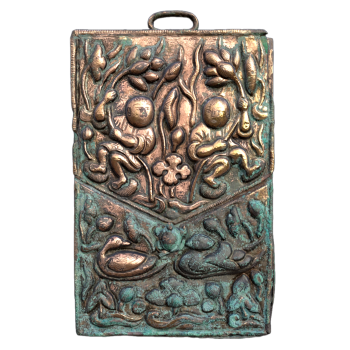
This relic is a box of sutras known as the "container of Tibetan sutras", from the Korean Koryo period (918-1392) around 1100 AD. It is made of gold-plated copper with embossed decorations, and the overall dimensions are 10.2 x 6.5 x 1.5cm. This sutra box was once used to preserve miniature Buddhist sacred texts. By hammering the reverse side, the front and back of the box are engraved with relief designs depicting a peaceful pond boy holding a huge lotus in his hand and a pair of mandarin ducks swimming. These playing boys may represent the newly born soul in the Pure Land. Collected at the Cleveland Museum of Art.
King Kong Lex Hum

King Kong Lex Hum

The door gods are known in Japan as the Kongers, and their role is to protect the temple and Buddhism. Door gods (Niō) usually appear in pairs, with one mouth open and one mouth closed. Those who open their mouths are called A, and those who close their mouths are called Hum. Corresponds to the second generals of Chinese Buddhism. These two names stand for the first and last syllables in Sanskrit, symbolizing the beginning and end of all things. The pair of statues are now in the collection of the Cleveland Museum of Art.
King Kong, Hercules

King Kong, Hercules

The door gods are known in Japan as the Kongers, and their role is to protect the temple and Buddhism. Door gods (Niō) usually appear in pairs, with one mouth open and one mouth closed. Those who open their mouths are called A, and those who close their mouths are called Hum. Corresponds to the second generals of Chinese Buddhism. These two names stand for the first and last syllables in Sanskrit, symbolizing the beginning and end of all things. The pair of statues are now in the collection of the Cleveland Museum of Art.
Dancing King Kong Hai Mother

Dancing King Kong Hai Mother

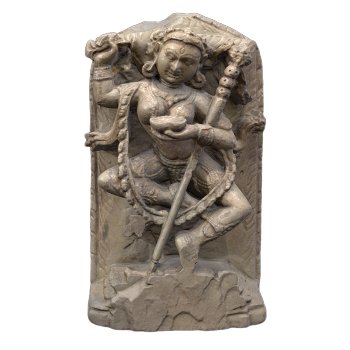
This is a small stone tablet called "Dancing King Kong Hai Mother", created in Nepal from 1000 to 1100 AD. The overall size of the statue is 9.6 x 5.3cm. The statue is now in the collection of the Cleveland Museum of Art. King Kong Hai Mother, also known as King Kong Yoga Mother, is one of the Buddhist King Kong (Tantra) statues and belongs to the system of empty mothers. The Ming concubine of Shengle King Kong and Great Compassion Red Guanyin originated in India from the 8th to the 12th centuries. The mother-to-mother revered by the four major sects is mainly used to make the spirit of the treasure bottle and the concept of self-determination.
Juniper Foal Dog Right

Juniper Foal Dog Right

The pair of foals are artifacts from the Kamakura period (1185-1333) in Japan. They are made of Japanese cypress wood with lacquer, gold leaf and color. The height of this foal is 45.7cm. Colts are usually placed at the entrance to the shrine to ward off evil. The colt on the right has an open mouth, while the colt on the left has a closed mouth. These characteristics are related to the opening and closing of the two door gods who protect Buddhist temples. Collected at the Cleveland Museum of Art.
Juniper Foal Dog Left

Juniper Foal Dog Left

The pair of foals are artifacts from the Kamakura period (1185-1333) in Japan. They are made of Japanese cypress wood with lacquer, gold leaf and color. The height of this foal is 42.5cm. Colts are usually placed at the entrance to the shrine to ward off evil. The colt on the right has an open mouth, while the colt on the left has a closed mouth. These characteristics are related to the opening and closing of the two door gods who protect Buddhist temples. Collected at the Cleveland Museum of Art.
Why was born into slavery, created by Jean Baptiste Calvo

Why was born into slavery, created by Jean Baptiste Calvo

As one of the most powerful expressions of abolitionist sentiment in visual art, "Why Born Enslaved!" depicts an African woman who is bound by ropes and provocatively looks up. The rope painfully pressed against her breasts; Her tattered shirt hinted at the violence that caused her illness. The original colored surface is covered with complex and intricate shadows and subtle shapes. There is evidence to suggest that this masterpiece of 19th-century French sculpture is the primary model for numerous castings in other museum collections. It is currently housed in the Cleveland Museum of Art.
Japanese Heian period woodcarving 'Shintoism'

Japanese Heian period woodcarving 'Shintoism'

God is the name of a deity related to the traditional Shinto religion in Japan. It is said that they were originally created for the Usa Hachiman Shrine in Oita, Kyushu. The Usa Hachiman Shrine has four main deities: Himeji Daisen, who helps those engaged in agriculture and sea travel; The legendary Emperor Chongjun of the 5th century was deified as the Divine Hachiman; Empress Jin Gu; And the deity of Kawahara Mountain who helped copper miners. The identities of these two characters are not yet clear, but they belong to a larger group that includes at least three other deities. The wooden carvings were first collected at the Cleveland Museum of Art.
Korean Goryeo period celadon teapot

Korean Goryeo period celadon teapot

A celadon teapot from the Goryeo period in Korea (918-1392), made around 1100 AD. The outer diameter of this celadon is 7.2 centimeters, and the overall height is 4.2 centimeters. This celadon is engraved with a scroll design, and many celadon ceramics have been repaired with gold paint. In Japan, this repair method is called "Jinji" (meaning "gold bonding"), which uses a mixture of shiny gold powder and paint to repair damaged parts. This teapot is currently housed in the Cleveland Museum of Art.
Maya style pottery engraved with golfers

Maya style pottery engraved with golfers

This is a Maya style pottery from Yucatan, Mexico, made around 600-1000 AD. The diameter of this pottery is 18.1 x 15.6 centimeters, and the overall height is 18 centimeters. This pottery depicts the image of a Maya player wearing heavy protective gear to prevent injury during the game. This pottery is currently housed in the Cleveland Museum of Art.
Maya pottery from the classical period
Maya pottery from the classical period

This pottery belongs to the Maya culture, originating from the late classical period of the 7th to 10th centuries AD in Central America, the region of Nibaha. It is made of ceramic and talc, with an overall size of 16.9 x 15.3 x 15.3 centimeters. This pottery may have been used as a political gift, depicting scenes of captured prisoners after battle. The pictographic characters surrounding the edges are specifically designed for this container, used for drinking high-quality beverages made from cocoa beans. This container is currently housed in the Cleveland Museum of Art.
Silver Bowl from the Sassanid Dynasty

Silver Bowl from the Sassanid Dynasty

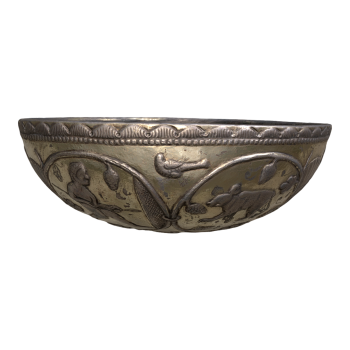
This bowl is a cultural relic from the Sassanid Dynasty (224-651 AD), originating from Iran. It is made of silver and has an overall size of 5 x 13.4 centimeters. The people of the Sassanid dynasty attached great importance to the enjoyment of life. It is said that a good Zoroastrian should divide his day into three parts: farming, philosophical thinking, and eating, resting, and enjoying. The abundance of luxury goods in the Sassanid dynasty proves their emphasis on the last part of life. This bowl is currently housed in the Cleveland Museum of Art in the United States.
Cape of Saint Blaise

Cape of Saint Blaise

This ivory carved Cape of Saint Blaise was discovered in the 12th century in southern Italy or Sicily. Ivory as a whole: 12 centimeters. It is currently housed at the Cleveland Museum of Art. Its shape is exquisite, with a series of six carved bands, and the outer ring depicts a hunting scene. The earliest existing inventory of St. Blaise Church from 1482-85 lists an olivine decorated with silver rings and gemstones, known as the 'Cape of St. Blaise'. By the 17th century, it was said that Saint Bryce used this horn to summon believers to worship.
The Divine Wood Statue of Shintoism in Japan

The Divine Wood Statue of Shintoism in Japan

This sculpture represents a god of Shintoism, produced during the Heian period in Japan (794-1185). It is carved from a piece of wood and represents the image of a courtier during the Heian period. At that time, the royal family was endowed with divinity, to the extent that some nobles were deified and revered as gods after their death. This sculpture measures 53.3 x 47 cm and was purchased from the Cleveland Museum of Art in 1978.
The Buddha Stele from the Eastern Wei Dynasty
The Buddha Stele from the Eastern Wei Dynasty

This stone monument is a cultural relic from the Eastern Wei Dynasty in China (534-550 AD) and is currently housed in the Cleveland Museum of Art in the United States. According to the inscription, this stone tablet was commissioned by King Yuanning of Gaoping in 537 AD to commemorate his deceased concubine, hoping that it could take her to the Western Paradise. Here, the Buddha's robe displays carefully arranged decorative patterns (large U-shaped folds and scallop shaped folds at the hem), combining linear rhythm and ordered symmetry. The mandala (almond shaped halo) on the edge of the flame echoes the linear eloquence of Chinese painting.
Qing Dynasty boxwood carving "Dao Xian He Xian Gu"
Qing Dynasty boxwood carving "Dao Xian He Xian Gu"

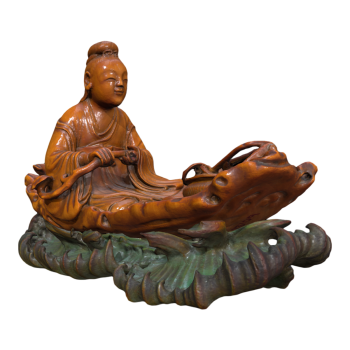
This is a sculpture called 'Taoist Immortal He Xiangu', made in the 1700s during the Qing Dynasty of China (1644-1911). This sculpture is made of boxwood, with a base of colored ivory and an overall height of 13.5 centimeters. He Xiangu is one of the Eight Immortals of Taoism. It is said that she was a real person during the Tang Dynasty, originally named He Qiong. In this exquisite carving, He Xiangu sits calmly on a twisted and multi jointed raft surrounded by green ivory waves. In front of her was a bamboo basket filled with items related to Taoist immortality, while she held a branch of Ganoderma lucidum.
The Plate with Winged Griffon

The Plate with Winged Griffon

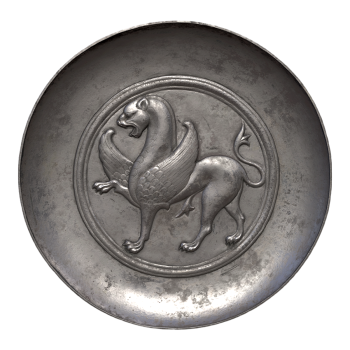
The 'Plate with Winged Griffin' is a cultural relic located at the Crancliff Art Museum, made of silver and measuring 4 x 32 centimeters (1 9/16 x 12 5/8 inches) in diameter. This work was made during the Hephtalite period (6th to 7th centuries) in the Soghdia region, around 500-600 AD. This work depicts a winged griffin, a mythical creature often depicted as a mixture of lion and eagle, symbolizing strength and nobility.
The Water Lilies, created by Claude Monet

The Water Lilies, created by Claude Monet

Claude Monet's "Water Lilies" is a series of approximately 250 oil paintings created by French Impressionist painter Monet between the late 1890s and his death in 1926. This painting is part of Claude Monet's "Water Lilies" series, titled "Water Lilies", and is currently housed in the Cleveland Museum of Art. This painting was originally the left part of a triptych, with lilies in the foreground. However, in the later creative process, Monet removed the lilies, leaving only the water lilies floating on the surface. Therefore, this triptych originally called "Lily Flower" is now called "Water Lilies (Lily Flower)".